Metamaterials designed by AI for sustainable steel applications
4 November 2026
Steel is essential in the automotive industry for its durability and strength, but its production generates a significant amount of CO2 emissions. Researchers at the UvA Institute of Physics have found that mechanical metamaterials can help reduce this footprint. Metamaterials are engineered materials that get their properties from their internal structure instead of the substance they are made of.
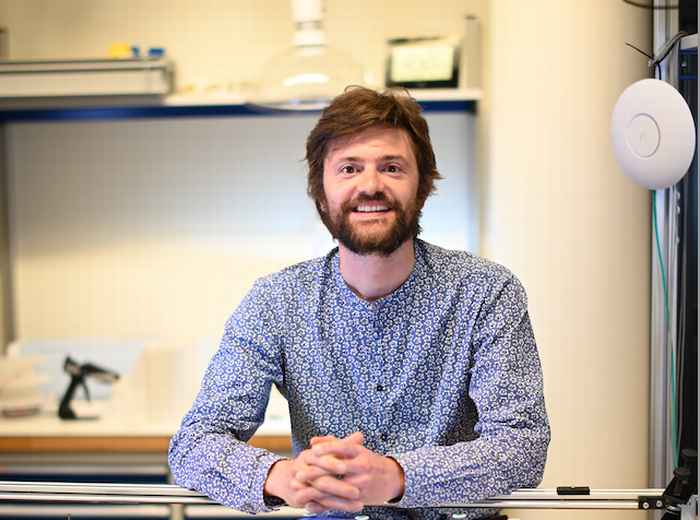
In an UvA MMD TechHub project, full professor Corentin Coulais (Insitute of Physics) and associate professor Jan-Willem van de Meent (Informatics Insitute) design metamaterials for protective casings for electric-car batteries. These casings must be very strong but also as light as possible. Coulais explains: 'The main idea is to make electric cars lighter, because that increases the range and reduces tire wear. That way, you need less electricity and produce less pollution.'
Normally, Coulais uses trial and error to find the right geometries for a specific application of their metamaterials. However, in this project, Coulais and AI expert Van de Meent want to automate the optimization of metamaterials using AI techniques.
Layer by layer
In earlier research, Coulais’ group developed metamaterials that combine two usually conflicting properties: they are stiff enough to support substantial weight while also absorbing sudden impacts efficiently. Their stiffness means less material is needed, making the material lighter than conventional alternatives.
Coulais explains: 'When compressed, the material collapses layer by layer. This way, it absorbs energy more progressively and it can absorb more energy overall.' That makes these metamaterials very useful as shock absorbers for vehicles, for example.
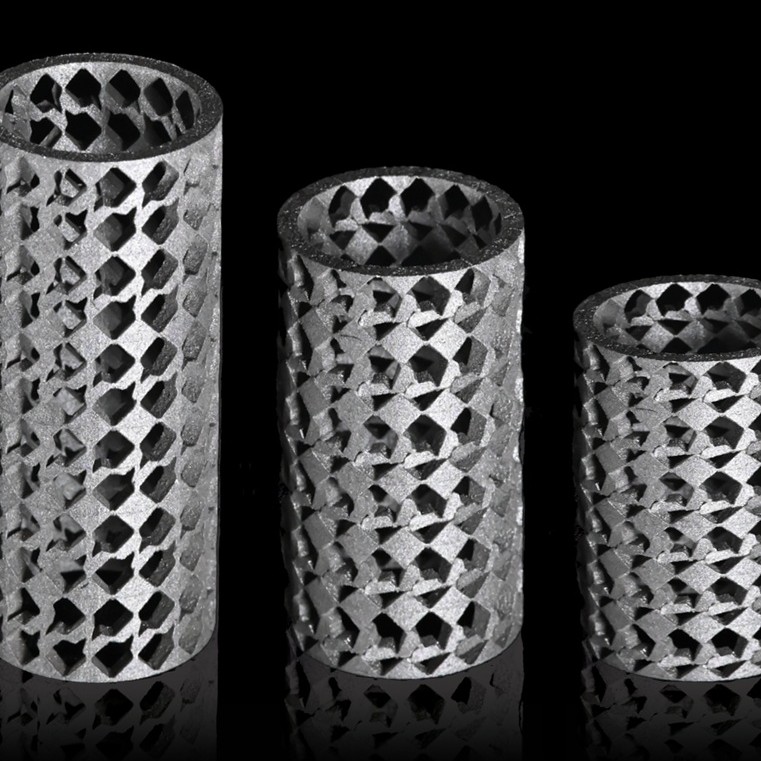
Using AI techniques, the researchers aim to optimize the material's geometry to maximise energy absorption. Another important property for shock absorption is that the load is distributed away from the point of impact. Therefore, Coulais and Van de Meent are looking to optimise both energy absorption and spreading the load.
Simulation
An important part of the project is carried out by postdoc researcher Daniel Acuña, who is developing a model that can quickly and accurately simulate metamaterials. One of the challenges is to make a simulation model that is also compatible with an optimisation tool, which compares the different geometries in the simulation.
The researchers use a technique commonly used in neural networks, a type of machine learning, as an optimisation tool. This tool, named automatic differentiation, compares two simulations with different parameters and tells the researchers which changes in the parameters yield a better result.
To find a way to make both the simulation and optimisation tool work well together, the researchers are also optimising the simulator itself using the optimisation tool. Coulais explains: 'Sometimes when you go to extreme geometries, the simulation tool will not work very well. We now use this very interesting concept, where we improve both the quality of the simulator and the geometry. No one has done that in this context before.'
Although most of the development at the moment is computational, the researchers are also planning to do experiments to validate the results from the simulations.
Impact
Coulais is particularly excited about using their computational tools to create designs that outperform others that were previously impossible to improve. 'I'm excited about the method, but also about the prospects of using it to make something that is actually better,' he says.
The research project has encouraged the scientists from different fields to work more closely together. 'I find this a really interesting tool that brings these two fields together,' says Coulais. 'I think there's lots more to do in that area and I'm excited about that. We can all contribute in a way that we get more than the sum of our parts.'